 |
plc.myforum.ro
PLCs users www.plc.myforum.ro!
|
| View previous topic :: View next topic |
| Author |
Message |
mamiko
Member 2


Joined: 25 Dec 2017
Posts: 420
|
 Posted: 20/02/2023 19:28 Post subject: PROFINET topology for non-CiR-compatible IO devices Posted: 20/02/2023 19:28 Post subject: PROFINET topology for non-CiR-compatible IO devices |
 |
|
What do you have to consider for non-CiR-compatible IO devices in conjunction with PROFINET and configured topology?
https://support.industry.siemens.com/cs/document/109749355/
When using IO devices that do not support CiR (Configuration in Run), in some cases there are limitations, for example, IO devices cannot be added or removed at all points with configured topology or disabled ports. This entry explains this behavior using different configuration examples.
Introduction
Whether an IO device can be added or removed during operation (in Run) is not dependent on whether or not the device itself supports CiR. What is important is that the neighboring devices have to support CiR if the interface parameterization is to be changed during a CiR/H-CiR procedure.
Interface parameterization includes among other things the enabling and disabling of ports and the changing of configured topology. If one of these steps is necessary for adding or removing, the requirement is that the neighboring devices support CiR.
In the following example it is assumed that the topology is configured and that this has to be changed when an IO device is added or removed. In the configuration example we use the following color markings:
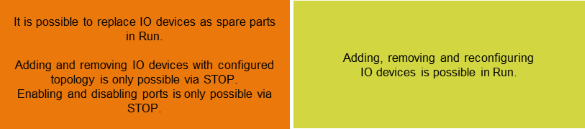
Fig. 01
Limitation
In the following example we consider only the effects of non-CiR-compatible IO devices in conjunction with topology configuration or the enabling and disabling of ports.
We also conține additional recommendations and notes, for example about setting the update time and the LLDP mode. More information about this is available in the application example:
"PROFINET in SIMATIC PCS 7 – Guidelines and Blueprints"
https://support.industry.siemens.com/cs/document/72887082/
Standard automation system AS 410
Changing the parameters of the internal PN interfaces of the CPU 410 is only possible with H systems as an H-CiR procedure, this means that in the direct neighborhood of the CPU no IO devices can be added or removed in Run with standard automation systems. After the first IO device this limitation has no more effect.
Standard automation system AS 410 with non-CiR-compatible IO devices
In the neighborhood of non-CiR-compatible IO devices no IO devices can be added or removed in Run.
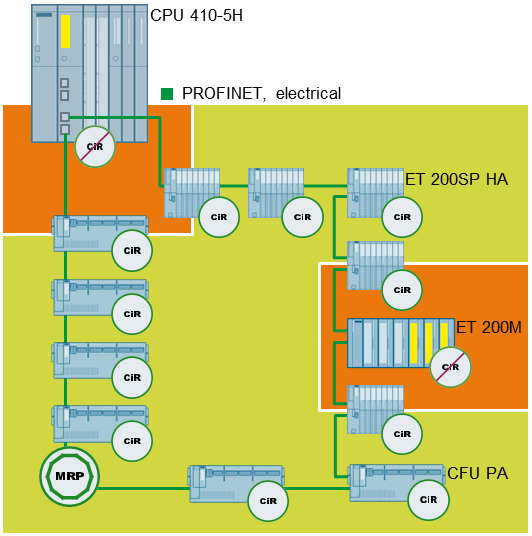
Fig. 02
Standard automation system AS 410 with switches
For process industry the SCALANCE switches XC-200, XF204-2BA and XP-200 are recommended. These switches are PA ready and support CiR. When using other non-CiR-compatible switches no IO devices can be added or removed in Run in the neighborhood.
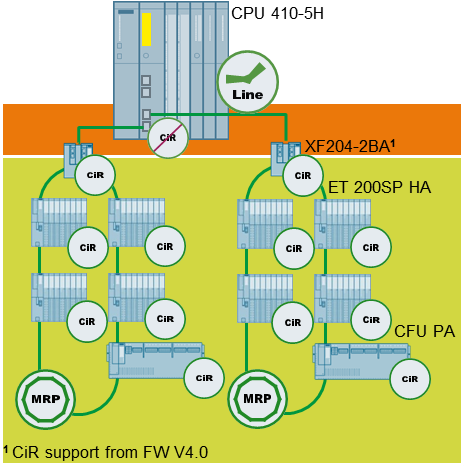
Fig. 03
Note
If you add or remove devices within an MRP ring, a warning is issued in the Operator Station.
High availability automation system
If you are using an AS 410 high availability automation system and all the IO devices in your plant support CiR, you can make changes in Run at any time at any point in the plant, including the adding and removing of IO devices.
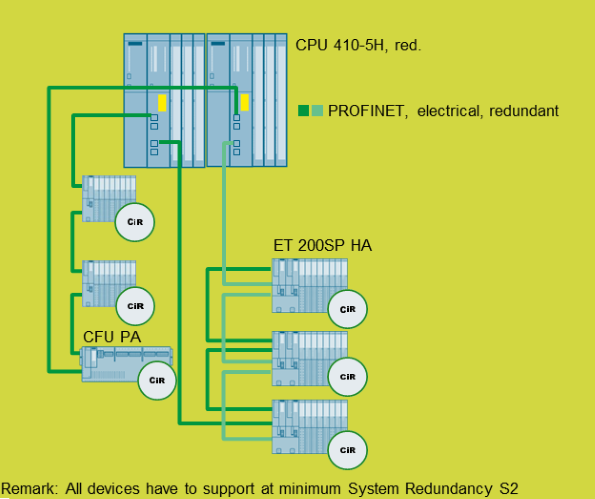
Fig. 04
High availability automation system with non-CiR-compatible IO devices
You cannot change the interface parameterization of non-CiR-compatible IO devices in Run, which means
that in the neighborhood of these IO devices you cannot add or remove any IO devices in Run.
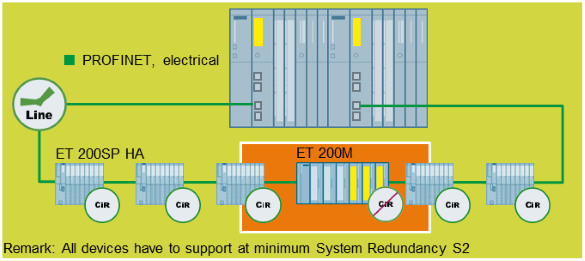
Fig. 05
High availability automation system AS 410 with switches
For process industry the SCALANCE switches XC-200, XF204-2BA and XP-200 are recommended. These switches are PA ready and support system redundancy S2 and CiR.
Switches without system redundancy S2 can only be incorporated unilaterally in the H system and behave as follows in the H-CiR procedure:
The switching function is retained.
The connection to IO devices after the switches remains available without limitation.
There is failure of the application relationship between switch and CPU and ensuing device failure of the switch until the assigned CPU is restored. During the failure there is no switch diagnostics data available in the H system.
It is possible to change the interface parameterization.
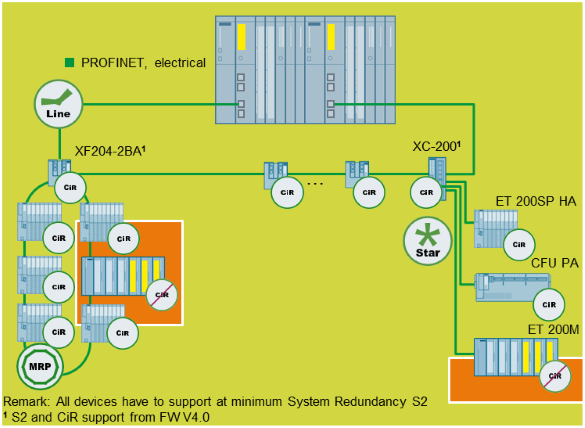
Fig. 06
Note
If you add or remove devices within an MRP ring, a warning is issued in the Operator Station.
High availability automation system with switches in a redundant PROFINET configuration (R1)
You can only incorporate switches unilaterally in a redundant PROFINET configuration (R1). Therefore they behave as follows in the H-CiR procedure regardless of whether or not they support CiR:
The switching function is retained.
The connection to IO devices after the switches remains available without limitation.
There is failure of the application relationship between switch and CPU and ensuing device failure of the switch until the assigned CPU is restored. During the failure there is no switch diagnostics data available in the H system.
It is possible to change the interface parameterization.
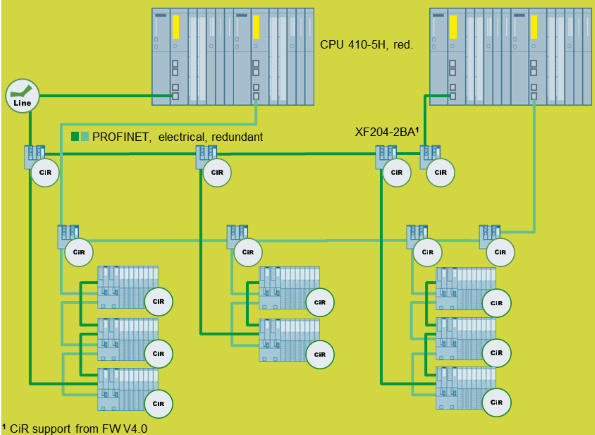
Further Information
An overview of all the relevant information for implementing PROFINET solutions in SIMATIC PCS 7 is available
https://support.industry.siemens.com/cs/document/72887082/profinet-in-process-automation-with-simatic-pcs-7 |
|
| Back to top |
|
 |
|
|
You cannot post new topics in this forum
You cannot reply to topics in this forum
You cannot edit your posts in this forum
You cannot delete your posts in this forum
You cannot vote in polls in this forum
|
Powered by phpBB © 2001, 2005 phpBB Group
Fa-ti si tu propriul forum GRATUIT, pe www.myforum.ro |
 FAQ
FAQ Search
 Memberlist
 Usergroups
 Register
 Profile
 Log in to check your private messages
 Log in


