 |
plc.myforum.ro
PLCs users www.plc.myforum.ro!
|
| View previous topic :: View next topic |
| Author |
Message |
gert
Member 3


Joined: 02 Jan 2015
Posts: 645
|
 Posted: 07/12/2019 19:29 Post subject: Positioning a drive with standard telegram 9 Posted: 07/12/2019 19:29 Post subject: Positioning a drive with standard telegram 9 |
 |
|
Positioning a drive with standard telegram 9
https://support.industry.siemens.com/cs/document/109765912/
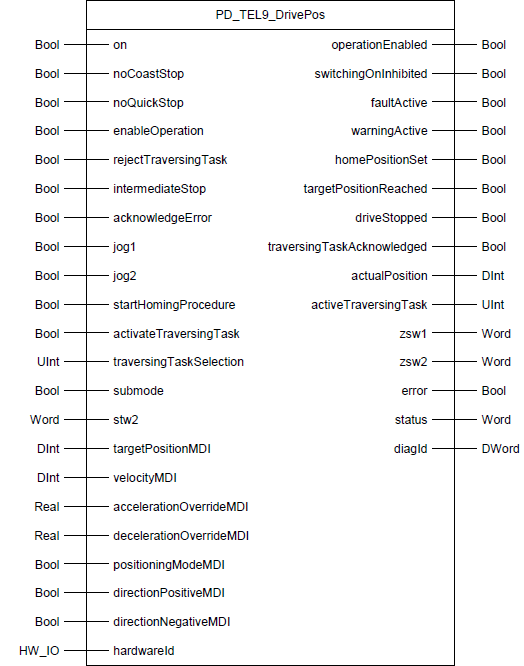
The function block PD_TEL9_DrivePos enables simple positioning of a drive via positioning records or manual data entry with standard telegram 9.
Standard telegram 9 enables the positioning of a drive via positioning records and manual data entry according to application class 3 of DIN EN 61800-7-203. The standard telegram 9 specifies two modes for positioning a drive:
Program mode
Positioning via traversing blocks
Manual Data Input (MDI)
Manual positioning
When positioning via traversing blocks, up to 1024 traversing blocks can be defined in the drive. Each traversing block contains all necessary parameters such as position and dynamic specifications. For manual data entry, the position and dynamic settings must be transferred from the controller to the drive.
The function block PD_TEL9_DrivePos enables simple positioning of a drive via positioning records or manual data entry. The bits of the control, status and signal words that are relevant for positioning are broken down into the block input and block output parameters.
Downloads
https://support.industry.siemens.com/cs/attachments/109765912/109765912_DrivePosPdTel9_en.pdf
https://support.industry.siemens.com/cs/dl-media/109765912/109765912_DrivePosPdTel9_html_en/start.html
https://support.industry.siemens.com/cs/attachments/109765912/109765912_PD_TEL9_DrivePos_LIB_V10.zip
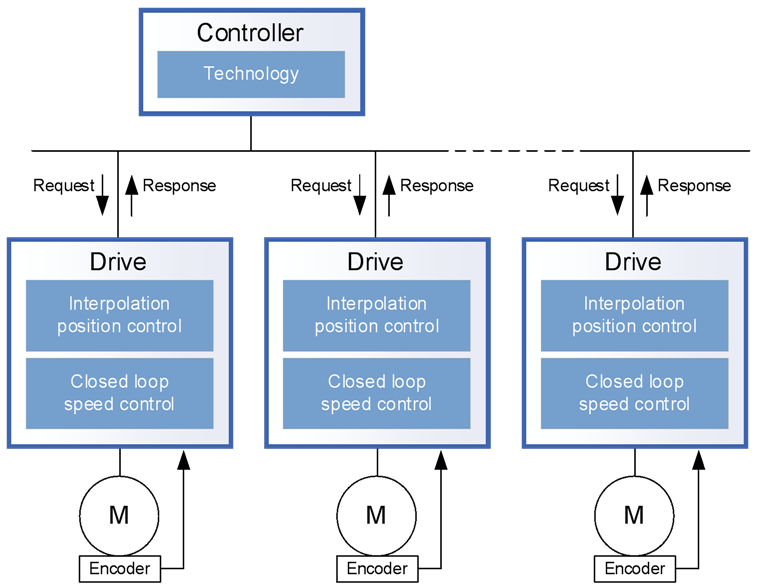
In DIN EN 61800-7-203, the PROFIdrive profile defines six application classes which cover the full range of drive applications. Drives in application class 3 can perform positioning requests in addition to the speed and position control. Thus, the automation process is located entirely in the controller but positioning commands are executed directly in the drive. The interpolation of the position as well as the position and speed control are calculated in the drive and then executed. The single-axis drive is responsible for the positioning and sends the positioning status cyclically to the controller. Because all time-critical calculations are done in the drive device, a clock synchronous controller is only needed when coordinating the movement of multiple axes.
Figure 1-1 Application class 3
1.1 Standard telegram 9
Standard telegram 9 allows the positioning of a drive via positioning tasks and manual data input as per application class 3 of DIN EN 61800-7-203.
Standard telegram 9 specifies two modes for positioning a drive:
Program mode Positioning via traversing tasks
Manual Data Input (MDI) Manual positioning
When positioning with traversing tasks, up to 1024 traversing tasks can be defined in the drive. Each traversing task contains all the necessary parameters such as position and dynamic parameters. For manual data input, the position and the dynamic parameters must be transferred from the controller to the drive.
Note
DIN EN 61800-7-203 dictates an implementation of the traversing task selection. However, support for manual data input is optional.
1.1.1 Structure of the telegram
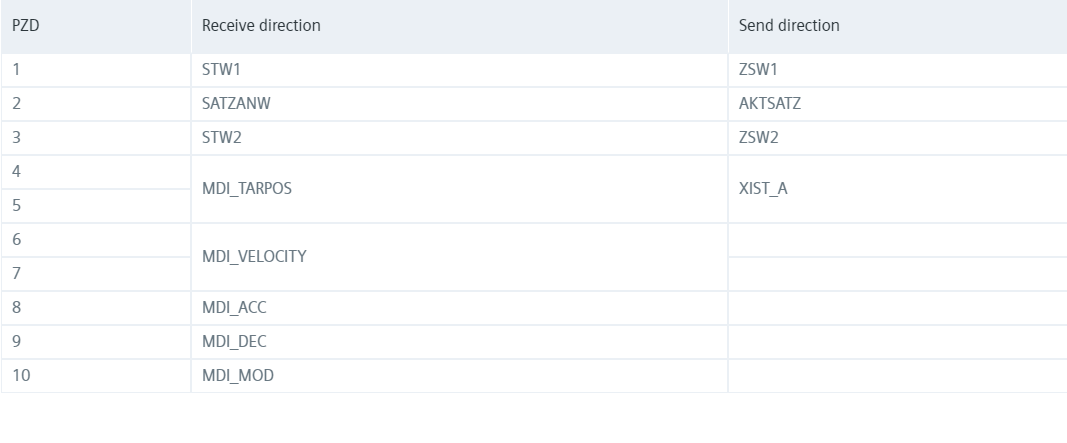
Standard telegram 9 consists of ten receive words and five send words.
From the point of view of the drive unit, the received process data represent the receive words and the process data to be sent represent the send words.
The receive and send words consist of the following elements:
Receive words: Control words or setpoints
Send words: Status words or actual values
Table 1-1 Standard telegram 9 structure
https://ulozto.net/tam/_HNwv4yeGwr4q |
|
| Back to top |
|
 |
|
|
You cannot post new topics in this forum
You cannot reply to topics in this forum
You cannot edit your posts in this forum
You cannot delete your posts in this forum
You cannot vote in polls in this forum
|
Powered by phpBB © 2001, 2005 phpBB Group
Fa-ti si tu propriul forum GRATUIT, pe www.myforum.ro |
 FAQ
FAQ Search
 Memberlist
 Usergroups
 Register
 Profile
 Log in to check your private messages
 Log in


